
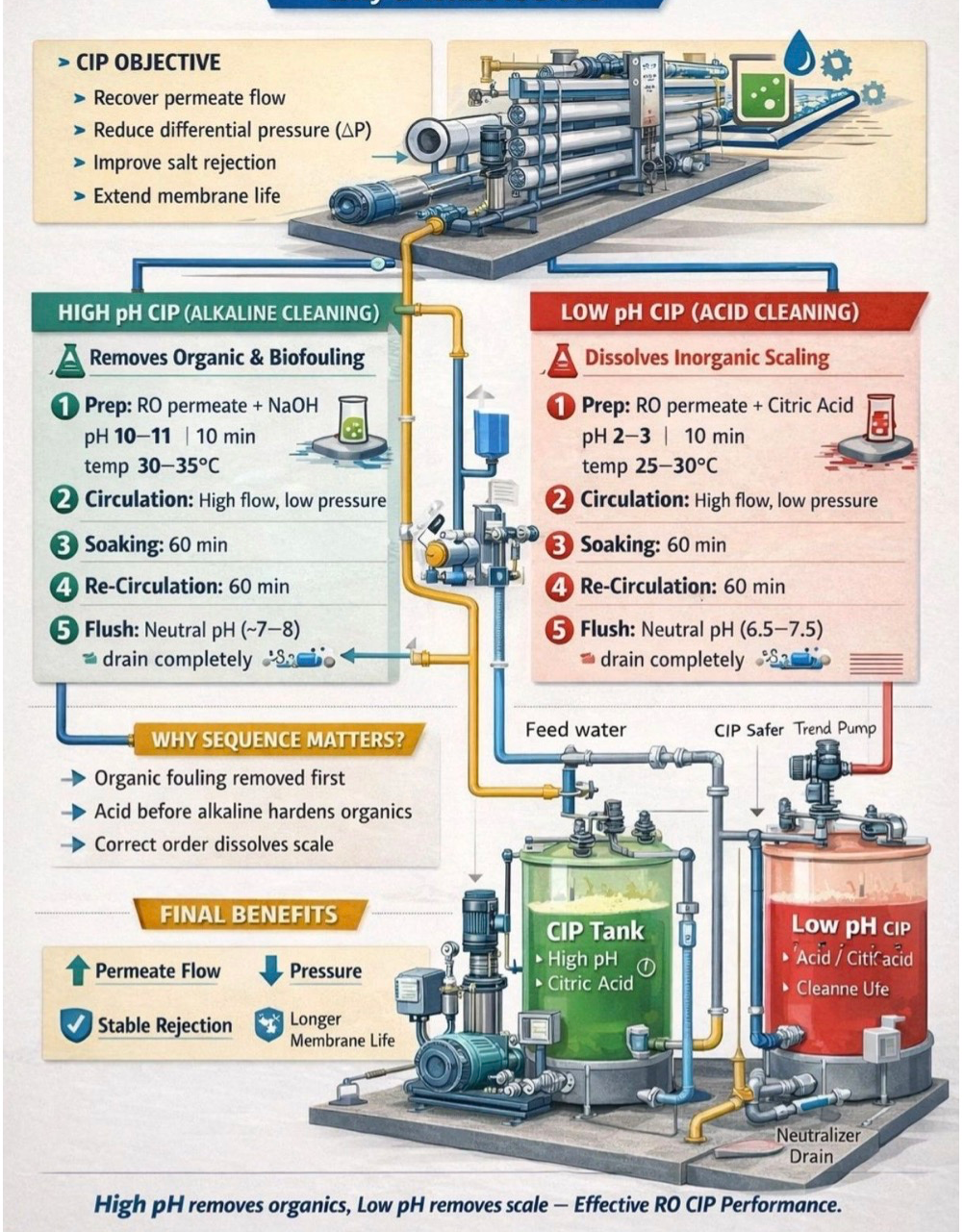
(High pH CIP → Low pH CIP) Why it is done & What it does. Sharing a practical RO CIP SOP followed in actual plant operations. Correct CIP sequence plays a critical role in membrane performance and life. 🔹 CIP OBJECTIVE (Overall Purpose) RO CIP (Cleaning-in-Place) is performed to remove fouling and scaling from the membrane surface in order to: • Recover permeate flow • Reduce differential pressure (ΔP) • Improve salt rejection • Extend membrane life. 🔹 HIGH pH CIP (ALKALINE CLEANING) Why is High pH CIP required? High pH CIP is carried out to remove organic and biological fouling. Organic matter is acidic in nature and becomes loosened or dissolved in an alkaline cleaning solution. What does High pH CIP do? • Removes organic fouling • Breaks biofouling (bacteria, algae, slime) • Cleans oil, grease and protein deposits • Opens membrane pores • Reduces ΔP and improves flux High pH CIP – Step by Step 1️⃣ Chemical preparation – 10 min • RO permeate + alkaline chemical • Target pH: 10.0–11.0 • Temperature: 30–35°C 2️⃣ Circulation – 120 min • High flow, low pressure • Organic layer loosens from membrane 3️⃣ Soaking – 60 min • Biofilm and stubborn organics soften 4️⃣ Re-circulation – 60 min • Loosened foulants fully detach 5️⃣ Flushing & drain • Flush till outlet pH ~7–8 • Mandatory before acid CIP 🔹 LOW pH CIP (ACID CLEANING) Why is Low pH CIP required? Low pH CIP is performed to dissolve inorganic scaling that cannot be removed by alkaline cleaning. What does Low pH CIP do? • Dissolves calcium carbonate (CaCO₃) scale • Removes calcium sulphate (CaSO₄) & metal scales • Cleans iron fouling (Fe³⁺ deposits) • Reactivates membrane surface • Normalizes pressure drop Low pH CIP – Step by Step 1️⃣ Chemical preparation – 10 min • RO permeate + acid chemical • Target pH: 2.0–3.0 • Temperature: 25–30°C 2️⃣ Circulation – 120 min • Scaling gradually dissolves 3️⃣ Soaking – 60 min • Hard scale softens and breaks 4️⃣ Re-circulation – 60 min • Dissolved scale completely removed 5️⃣ Flushing & drain • Flush till outlet pH 6.5–7.5 🔹 Why is the sequence fixed? (High pH → Low pH) ✔ Organic fouling must be removed first ✔ Acid cleaning before alkaline can harden organics ✔ Correct sequence allows acid to act directly on scale 🔹 FINAL BENEFITS • Maximum permeate flow recovery • Lower operating pressure • Stable salt rejection • Reduced CIP frequency • Longer membrane life 👉 High pH removes organics, Low pH removes scale — together they ensure effective RO CIP performance.


This is your website preview.
Currently it only shows your basic business info. Start adding relevant business details such as description, images and products or services to gain your customers attention by using Boost 360 android app / iOS App / web portal.
RO CIP PROCESS
2026-01-29T06:16:44
(High pH CIP → Low pH CIP) Why it is done & What it does. Sharing a practical RO CIP SOP followed in actual plant operations. Correct CIP sequence plays a critical role in membrane performance and life. 🔹 CIP OBJECTIVE (Overall Purpose) RO CIP (Cleaning-in-Place) is performed to remove fouling and scaling from the membrane surface in order to: • Recover permeate flow • Reduce differential pressure (ΔP) • Improve salt rejection • Extend membrane life. 🔹 HIGH pH CIP (ALKALINE CLEANING) Why is High pH CIP required? High pH CIP is carried out to remove organic and biological fouling. Organic matter is acidic in nature and becomes loosened or dissolved in an alkaline cleaning solution. What does High pH CIP do? • Removes organic fouling • Breaks biofouling (bacteria, algae, slime) • Cleans oil, grease and protein deposits • Opens membrane pores • Reduces ΔP and improves flux High pH CIP – Step by Step 1️⃣ Chemical preparation – 10 min • RO permeate + alkaline chemical • Target pH: 10.0–11.0 • Temperature: 30–35°C 2️⃣ Circulation – 120 min • High flow, low pressure • Organic layer loosens from membrane 3️⃣ Soaking – 60 min • Biofilm and stubborn organics soften 4️⃣ Re-circulation – 60 min • Loosened foulants fully detach 5️⃣ Flushing & drain • Flush till outlet pH ~7–8 • Mandatory before acid CIP 🔹 LOW pH CIP (ACID CLEANING) Why is Low pH CIP required? Low pH CIP is performed to dissolve inorganic scaling that cannot be removed by alkaline cleaning. What does Low pH CIP do? • Dissolves calcium carbonate (CaCO₃) scale • Removes calcium sulphate (CaSO₄) & metal scales • Cleans iron fouling (Fe³⁺ deposits) • Reactivates membrane surface • Normalizes pressure drop Low pH CIP – Step by Step 1️⃣ Chemical preparation – 10 min • RO permeate + acid chemical • Target pH: 2.0–3.0 • Temperature: 25–30°C 2️⃣ Circulation – 120 min • Scaling gradually dissolves 3️⃣ Soaking – 60 min • Hard scale softens and breaks 4️⃣ Re-circulation – 60 min • Dissolved scale completely removed 5️⃣ Flushing & drain • Flush till outlet pH 6.5–7.5 🔹 Why is the sequence fixed? (High pH → Low pH) ✔ Organic fouling must be removed first ✔ Acid cleaning before alkaline can harden organics ✔ Correct sequence allows acid to act directly on scale 🔹 FINAL BENEFITS • Maximum permeate flow recovery • Lower operating pressure • Stable salt rejection • Reduced CIP frequency • Longer membrane life 👉 High pH removes organics, Low pH removes scale — together they ensure effective RO CIP performance.
2026-01-29T06:16:44


Why it is do)

Keywords
- Salt rejection improvement methods
- Differential pressure reduction in RO
- Permeate flow recovery techniques
- Fouling and scaling removal RO
- Effective membrane cleaning procedures
- Acid cleaning for calcium carbonate scale
- Alkaline cleaning for biofouling
- Chemical cleaning RO membranes
- CIP sequence for membrane performance
- Inorganic scale removal from RO system
- Organic fouling removal in RO membranes
- Membrane cleaning in place SOP
- Low pH CIP for scale dissolution
- High pH CIP for organic fouling removal
- RO CIP cleaning process steps
Submit Your Enquiry